SELinux
The SELinux policy type (technical name Selinux) manages the
mandatory access control layer of nodes that run SELinux: Fedora, RHEL and
its rebuilds, SLES 16, openSUSE Leap 16 and new Tumbleweed installs. A
policy sets the enforcement mode, boolean values, per-domain permissive
exceptions, the enabled state of policy modules, Bor-deployed policy
modules written in CIL, file contexts and login mappings. This page
explains what the agent changes on the endpoint, how to build a policy in
the editor, how several policies are merged, and how to verify and
troubleshoot the result.
One type per mandatory access control system
Nodes that run AppArmor (Ubuntu, Debian, SLES 15) are managed by the AppArmor type. An SELinux policy bound to such a node reports inapplicable, unless it requires SELinux. A mixed fleet binds one policy of each type to the same group.
What it controls
For every bound policy the agent brings these things in line, in this order, and reports one compliance item per entry:
- Mode - Enforcing or Permissive, applied to the running kernel
(what
setenforcedoes) and toSELINUX=in/etc/selinux/configso it survives a reboot. Bor never writesdisabled. - Booleans - the policy's own switches (
deny_ptrace,use_nfs_home_dirs, thexguest_*kiosk switches), set persistently and at runtime with onesetsebool -Pcall per sync. - Exceptions - domains that run permissive while the rest of the
system stays enforcing, the safe alternative to switching a whole group
to permissive when one application misbehaves. Rendered into the Bor
module
bor-permissive. - Modules - enabling or disabling modules of the node's policy store
(
semodule -e/-d), and custom modules written in CIL that Bor installs asbor-<name>at its own priority (450 by default), so they never replace a distribution or administrator module. - File contexts - rules that label files matching a path expression,
as
semanage fcontextwould, rendered into the modulebor-filecontexts;restoreconapplies them to existing files when asked. - Logins - mappings of named accounts or groups to a confined SELinux
user (
user_u,staff_u), for kiosks and shared desktops. Needssemanageon the node. The__default__androotmappings are never changed by a policy.
Two switches shape what the policy means on nodes without SELinux:
Treat nodes without SELinux as non-compliant turns an inapplicable
result into a red one, which is what a hardening benchmark expects;
Prepare nodes where SELinux is disabled sets the configuration file to
permissive and requests a relabel at the next boot (/.autorelabel), so
that an administrator's reboot brings the node to the mode the policy
wants. The agent never reboots a node.
Everything the agent changes is recorded in
/var/lib/bor/agent/selinux-state.json the first time it is touched, and
restored when the key leaves every policy: the mode, each boolean's value,
each module's enabled flag, each login mapping, and the Bor modules.
Endpoint prerequisites
- SELinux active. The agent checks that
selinuxis in the kernel's LSM list and that/sys/fs/selinuxis mounted. On a node booted withselinux=0, or withSELINUX=disabledin the configuration, the policy is inapplicable (or non-compliant when it requires SELinux); the Prepare switch is the only thing the agent can do there. - The C tools of every SELinux installation:
setseboolandgetsebool,semodule,restorecon(policycoreutils,libselinux-utils). Nothing else is needed for modes, booleans, exceptions, modules and file contexts. semanage(policycoreutils-python-utils) for login mappings only; without it those entries are inapplicable. Fedora and RHEL Workstation install it; minimal installs may not.audit2allow(same package) andcheckmodule(checkpolicy) for the module proposal on the node page; without them the proposal says so.journalctlfor the denial summary; the records are read from the journal's audit transport, so auditd is not required.
The agent does not add packages; a missing tool shows up as an inapplicable item that names it.
Agent configuration
| Key | Default | Description |
|---|---|---|
selinux.config_path |
/etc/selinux/config |
The configuration file whose SELINUX= line the mode setting rewrites. Tamper-protected while a policy applies. |
selinux.modules_dir |
/etc/bor/selinux |
Where Bor writes the CIL sources of its modules before semodule installs them. Tamper-protected. |
selinux.module_priority |
450 |
The semodule -X priority of Bor modules; keeps them apart from the distribution's (100) and the administrator's (400). |
selinux.state_path |
/var/lib/bor/agent/selinux-state.json |
Record of every original value, restored when it leaves every policy. |
selinux.reconcile_interval |
5m |
Interval of the pass that re-asserts the mode, booleans and modules while a policy applies; 0 disables it. |
selinux.allow_mode_change |
true |
Let policies switch the node between enforcing and permissive. With false mode entries are inapplicable. |
selinux.allow_custom_modules |
true |
Install Bor modules (custom modules, exceptions, file contexts). With false those entries are inapplicable and modules installed earlier are removed. |
selinux.follow_audit |
true |
Follow the audit records so a manual setenforce, setsebool or semodule is reconciled within seconds; the periodic pass remains the backstop. |
selinux.tool_timeout |
5m |
Maximum run time of one semodule or setsebool call. |
mac.inventory_interval |
1h |
How often the node re-sends its status, booleans, modules and denial summary while connected. |
mac.denial_window |
24h |
How far back the denial summary looks. |
mac.collect_denials |
true |
Read the journal's audit records for the denial summary. |
mac.allow_actions |
true |
Answer proposal requests from the node page (holders of mac:operate). |
Create an SELinux policy
- Go to Policies -> Create a policy and choose SELinux in the System & security group.
- Pick a node from Show the state of at the top of the editor to see what that node does now next to every boolean and module; without a node the editor shows the union of what every node reported.
- Fill the tabs described below, review the summary and save. Release the policy and bind it to a node group; start with a pilot group when the policy changes the mode or process-hardening booleans.
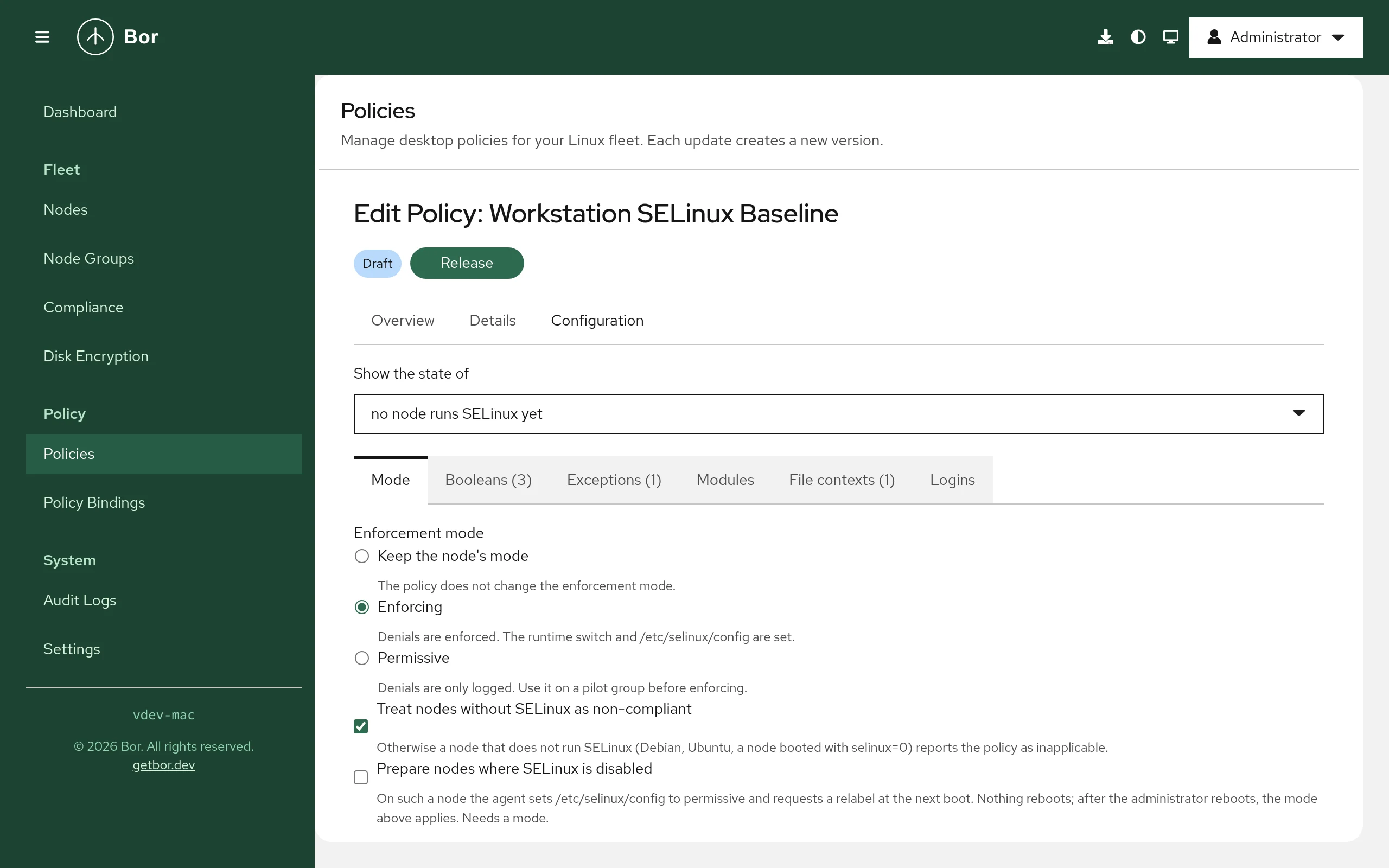
Editor sections
- Mode
- Keep the node's mode, Enforcing or Permissive (the editor asks for a confirmation before permissive, because it disables enforcement on every bound node). Below it the two switches for nodes without SELinux: treat them as non-compliant, and prepare disabled nodes.
- Booleans
- Search what nodes reported plus the server's curated list of the
booleans that matter on desktops, grouped (process hardening, users
and logins, home directories and shares, desktop services, identity,
developer workstations). Adding a boolean proposes its hardened value
when the list knows one. Each row has the value switch and an optional
note. Values that can lock users out or break desktop applications
(
unconfined_loginoff,deny_execmemon,selinuxuser_execstackoff, anyxguest_*change, turning network home directories off) are marked. Add a template adds a group in one click: Process hardening, Network home directories (NFS) and (Samba), Kiosk and guest accounts, Developer workstation. - Exceptions
- The domains that run permissive. With a node selected, the domains denied on that node recently are offered as one-click additions, so the exception is for a domain that is actually failing.
- Modules
- Existing modules from the node's store with an enable/disable switch,
and custom modules: a name (installed as
bor-<name>), a note and the CIL source. Insert a template adds a commented skeleton: allow a domain to read a directory, allow a connection to a port type, or silence a harmless denial. The server checks the source for balanced parentheses and a statement allowlist;semoduleon the node reports anything else. A Bor scheduled task can run under a type declared in a custom module: setSELinuxContexton the task in a Services & timers policy. - File contexts
- A path expression (
/opt/corpapp(/.*)?), the SELinux type, the file kind, and whether to relabel the literal prefix at once. Expressions that would relabel a system directory as a whole are refused. - Logins
- A login or
%group, the SELinux user and an optional range.
Setting reference
| Setting | Field | Values | What the agent does |
|---|---|---|---|
| Mode | mode |
SELINUX_MODE_ENFORCING, SELINUX_MODE_PERMISSIVE |
writes /sys/fs/selinux/enforce and SELINUX= in the configuration file |
| SELinux required | requireActive |
bool | a node without SELinux is non-compliant instead of inapplicable |
| Prepare disabled nodes | prepareDisabledNodes |
bool (needs a mode) | on a disabled node: SELINUX=permissive and /.autorelabel |
| Boolean | booleans[].name, .value |
name, bool | setsebool -P name=on|off, one call per sync |
| Exception | permissiveDomains[] |
<domain>_t |
(typepermissive <domain>) in bor-permissive |
| Module | modules[].name, .enabled |
name, bool | semodule -e / -d |
| Custom module | customModules[].name, .cil |
name, CIL text (64 KiB) | semodule -X 450 -i bor-<name>.cil |
| File context | fileContexts[].pathRegex, .type, .kind, .restorecon |
regex, type, kind, bool | (filecon ...) in bor-filecontexts, then restorecon -R <prefix> |
| Login | logins[].login, .seuser, .range |
login or %group, SELinux user, range |
semanage login -a/-m -s <seuser> [-r <range>] <login> |
Protected: the boolean secure_mode_policyload cannot be set by a policy
(it would lock the policy against every later change, including Bor's);
modules named bor-* are not managed through the module switches; the
__default__ and root login mappings cannot be changed.
Example: enforcing baseline
{
  "mode": "SELINUX_MODE_ENFORCING",
  "requireActive": true,
  "booleans": [
    {"name": "selinuxuser_execstack", "value": false, "description": "No executable stack for user programs"},
    {"name": "deny_ptrace", "value": true, "description": "No ptrace for anyone"}
  ]
}
Example: network homes and an exception
{
  "booleans": [{"name": "use_nfs_home_dirs", "value": true}],
  "permissiveDomains": ["corpvpn_t"],
  "fileContexts": [{"pathRegex": "/opt/corpapp(/.*)?", "type": "bin_t", "restorecon": true}]
}
Merge behavior
Several SELinux policies bound to one node are merged per key by binding priority (the highest priority among the enabled bindings that reach the node). The highest priority wins every key. On equal priority:
- the mode: enforcing beats permissive;
- booleans, module switches, custom modules, file contexts and logins with different values are a conflict: neither is applied and both policies show an error item naming the other, until one binding gets a higher priority;
- exceptions are a union: a domain listed by any policy is permissive.
An entry a higher-priority policy decided differently is reported as inapplicable ("overridden by policy ...") for the losing policy.
What the agent changes on the node
| Path or state | Written by | Watched |
|---|---|---|
/sys/fs/selinux/enforce |
the mode | reconciled |
/etc/selinux/config (SELINUX= line only) |
the mode | yes |
booleans (setsebool -P) |
booleans | reconciled |
the policy store, modules bor-permissive, bor-filecontexts, bor-<name> at priority 450 |
exceptions, file contexts, custom modules | reconciled |
/etc/bor/selinux/*.cil |
the module sources | yes |
/var/lib/bor/agent/selinux-state.json |
every original value | yes |
/.autorelabel |
the prepare switch | no (consumed by the next boot) |
Every CIL file Bor writes starts with the line ; Managed by Bor - changes
are overwritten.
A policy rebuild (semodule) takes about six seconds on a desktop; the
agent batches every module operation of a sync into one semodule call
and runs it off the policy stream. setsebool -P takes about one second.
A commit that finds the policy store locked (a package installing its
policy at the same time) is retried with a short back-off before the item
turns into an error.
On image-based systems (Fedora Kinoite and Silverblue) the policy store
is under /etc/selinux rather than /var/lib/selinux; the agent follows
store-root in semanage.conf, and everything works the same.
Drift handling
- Files Bor writes (the configuration file, the module sources, the state file) are guarded by the tamper watcher: an edit is reverted at once and reported as a tamper event.
- State that is not a file (the runtime mode, booleans, the enabled
flag of modules, login mappings) is re-asserted by the reconcile pass
every
selinux.reconcile_interval, and within seconds whenselinux.follow_auditis on: the agent follows the audit recordsMAC_STATUS(asetenforce),MAC_CONFIG_CHANGE(asetsebool) andMAC_POLICY_LOAD(asemodule) and reconciles. Each correction is a tamper event on the node's timeline with the resourceselinux:mode,selinux:boolean:<name>,selinux:module:<name>,selinux:custom:<name>orselinux:login:<login>, attributed to the login user the audit record names.
Removal and restore
When a policy is unbound, archived or deleted, the agent restores what it recorded: the mode the node had, each boolean's former value, each module's former enabled flag, each login mapping (removed when Bor created it), removes the Bor modules and their sources, and relabels the paths the file contexts covered. As with every Bor type, unbinding a hardening policy re-enables what it hardened; bind a successor first when that is not wanted.
The node details
The Mandatory access control section of a node shows what it runs
(SELinux and its mode, the policy type and version, the numbers of
booleans and modules, whether the policy is locked or a relabel is
pending), the booleans and modules it reported with their current values,
and the denials of the last report window grouped by domain, class
and target, with counts and one redacted example record. Holders of
mac:operate can ask the node for a module proposal: the agent runs
audit2allow over that domain's recent denials and returns the Type
Enforcement source and, when checkmodule and the policy tools are
present, its CIL translation, ready to review and paste into a custom
module. Nothing is applied by the proposal.
Compliance
One compliance item per entry, with the schema id naming its kind
(selinux:mode, selinux:boolean, selinux:permissive,
selinux:module, selinux:custom, selinux:fcontext, selinux:login,
selinux:active):
| State | Meaning |
|---|---|
| Compliant | the node shows the value the entry asks for |
| Non-compliant | the value differs (a manual change not yet reconciled, or a disabled node under a policy that requires SELinux) |
| Inapplicable | SELinux is not active, the boolean or module does not exist in this node's policy, a higher-priority policy decided otherwise, the agent configuration disables the feature, or semanage is missing for a login mapping |
| Error | an equal-priority conflict, or a tool failed (the message carries semodule's or setsebool's last line) |
The policy's status is inapplicable only when every item is; otherwise an error wins over non-compliant, which wins over compliant.
Verify on the endpoint
# Mode and configuration
getenforce; grep ^SELINUX= /etc/selinux/config

# Booleans the policy sets
getsebool deny_ptrace use_nfs_home_dirs

# Bor's modules and the store
semodule --list-modules=full | grep '^450 '
ls /etc/bor/selinux/

# Original values the agent will restore
cat /var/lib/bor/agent/selinux-state.json

# Denials and state changes
journalctl --since -1h _TRANSPORT=audit -o cat | grep -E 'avc:|MAC_STATUS|MAC_CONFIG_CHANGE'

# The agent's log
journalctl -u bor-agent | grep -i selinux
Troubleshooting
Every item is inapplicable with "SELinux is not active".
The node runs AppArmor or was booted with selinux=0. Check
/sys/kernel/security/lsm and /proc/cmdline. For a node with
SELINUX=disabled, enable Prepare nodes where SELinux is disabled
and reboot it once; the policy then applies.
A boolean is "does not exist in this node's policy".
Boolean names differ between policy versions and distributions; check
getsebool -a | grep <name> on the node.
A custom module shows an error from semodule.
The message is the tool's last line, usually an unknown type or class.
Types must exist in the node's policy; seinfo -t (package
setools-console) lists them, or use the proposal on the node page as a
starting point.
"policy locked".
secure_mode_policyload is on; no policy change is possible until the
node reboots. Bor never sets it.
Security considerations
- Custom modules, file contexts, login mappings and exceptions are
administrator-authored policy text. Creating, saving, releasing or
importing a policy that carries them requires the
mac:authorpermission on top of the policy permissions, and is audited aspolicy.mac_customwith the module names and a SHA-256 of each source; a node can refuse them withselinux.allow_custom_modules: falseand mode changes withselinux.allow_mode_change: false. - Denial records are aggregated on the node before they are reported:
user ids and names are dropped and home directories collapsed to
/home/*; the server keeps only the latest summary per node. - A proposal runs
audit2allowon the node and reads its audit records; it needs themac:operatepermission, is audited asmac.action, and applies nothing.